Sunday AFTER PENTECOST

Synaxis of All Saints
The Great Fast is upon us and that means it’s time for pierogies!
We will be selling perogies after our 4pm Divine Liturgy on March 15th.
All donations benefit our mission.
Cost: $15/dozen
Flavors: cheese, potato
Pick up location: St. Philip Neri ministry center, Fort Mill, SC
Payments: Cash or check only; payable to "Byzantine Catholic Mission"
Pre-orders: pre-order 3 dozen by March 5th; email petromissionfortmill@gmail.com. Please include full name & amount in email.
Get them while supplies last!
Do you think I should make the pre order deadline March 1st or keep it the 5th? As you saw, we are making them on the 9th at John's house.
SPN gave us a hard time about using their kitchen...they wanted a $500 usage + $500 cleaning fee...that would wipe out our whole proceeds.
For payments, does that sound good? We can't take venmo or zelle or anything like that. I will need to coordinate with John to withdraw $100 starting cash to make change for customers.
Do you think $100 is a good amount?The Sunday following Pentecost is dedicated to All Saints, both those who are known to us, and those who are known only to God. The Descent of the Holy Spirit makes it possible for us to rise above our fallen state and to attain sainthood, thereby fulfilling God’s directive to “be holy, for I am holy” (Lev. 11:44, 1 Peter 1:16, etc.). Therefore, it is fitting to commemorate All Saints on the first Sunday after Pentecost. This feast may have originated at an early date, perhaps as a celebration of all martyrs, then it was broadened to include all men and women who had borne witness to Christ by their virtuous lives, even if they did not shed their blood for Him. The feast of All Saints achieved great prominence in the ninth century, in the reign of the Byzantine Emperor Leo VI the Wise (886-911). His wife, the Holy Empress Theophano (December 16) lived in the world, but was not attached to worldly things. She was a great benefactor to the poor, and was generous to the monasteries. She was a true mother to her subjects, caring for widows and orphans, and consoling the sorrowful. Even before the death of Saint Theophano in 893 or 894, her husband started to build a church, intending to dedicate it to Theophano, but she forbade him to do so. It was this emperor who decreed that the Sunday after Pentecost be dedicated to All Saints. Believing that his wife was one of the righteous, he knew that she would also be honored whenever the Feast of All Saints was celebrated.
JUNE 29

Feast of Ss. Peter and Paul
This Feast honors the two apostles who were responsible for laying the foundation for the Church of Christ. Peter and Paul were martyred in Rome under the Emperor Nero in the year 67. Peter was crucified head down at his own request. Paul was a Roman citizen and, therefore, could not be crucified according to Roman law. He was beheaded. The Church unites them in a common celebration on June 29th and gives them identical honor. Peter was a simple fisherman who realized the holiness of Jesus the fist time he saw Christ. There is no doubt that Simon enjoyed a special relationship as a leader of the Apostles. Christ called him the “Rock” (Peter) and said that upon this Rock He would build His Church. Peter moved around in his apostolic work, consecrating bishops of villages and cities wherever he went. An important role of Peter and the Patriarchates founded by him was to speak on matters affecting the entire Church, including teachings and doctrine, both East and West, North and South. Saint Paul, on the other hand, had a different calling and role within the Church. His various letters to the Churches makes him the patron of the Local Church. Paul was raised in the strictest possible tradition of Pharisaic Judaism and was a Pharisee himself. He severely persecuted Christians until Christ met him in a powerful and intimate way. He went from being the most unlikely person to adapt Christianity to non-Jews, to being the Apostle of the Gentiles!
JULY 20
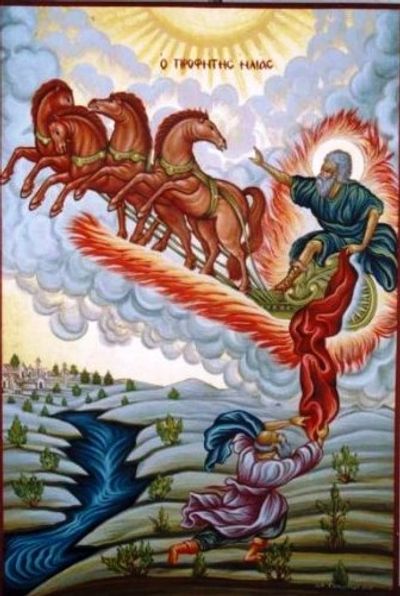
Feast of St. Elias (Elijah)
The Merciful Lord sent the prophet to appear before King Ahab, and proposed that two sacrificial altars be built: one for the priests of Baal, and the other for the Prophet Elijah who served the True God.The Prophet Elijah told them to call on their gods to consume the sacrificial animals with fire, and he would call on his. Whichever was first to send fire on the sacrifice would be acknowledged as the true God. The prophets of Baal called out to their idol from morning till evening, but the heavens were silent. Towards evening the holy Prophet Elijah built his sacrificial altar from twelve stones, the number of the tribes of Israel. He placed the sacrifice upon the wood, gave orders to dig a ditch around the altar and commanded that the sacrifice and the wood be soaked with water. When the ditch had filled with water, the prophet turned to God in prayer. Through the prayer of the prophet fire came down from heaven and consumed the sacrifice, the wood, and even the water. The people fell down to the ground, crying out: “Truly, the Lord is God!” Near the end of his life The Lord told him that the next day Elijah would stand in His presence. There was a strong wind that crushed the rocks of the mountain, then an earthquake, and a fire, but the Lord was not in them. The Lord was in “a gentle breeze” (3 Kings 19: 12). Because of his fiery zeal for the Glory of God the Prophet Elijah was taken up alive into Heaven in a fiery chariot.
According to the Tradition of Holy Church, the Prophet Elijah will be the Forerunner of the Dread Second Coming of Christ. He will proclaim the truth of Christ, urge all to repentance, and will be slain by the Antichrist. This will be a sign of the end of the world.
In iconography the Prophet Elijah is depicted ascending to Heaven in a fiery chariot, surrounded with flames, and harnessed to four winged horses. We pray to him for deliverance from drought, and to ask for seasonable weather.
October 1

Protection of the Theotokos
On Sunday, October 1, during the All Night Vigil, when the church was overflowing with those at prayer, the Fool-for-Christ Saint Andrew (October 2), at the fourth hour, lifted up his eyes towards the heavens and beheld our most Holy Lady Theotokos coming through the air, resplendent with heavenly light and surrounded by an assembly of the Saints. On bended knees the Most Holy Virgin tearfully prayed for Christians for a long time. After completing her prayer she took her veil and spread it over the people praying in church, protecting them from enemies both visible and invisible.
The Ever-Blessed Mother of God implored the Lord Jesus Christ to accept the prayers of all the people calling on His Most Holy Name, and to respond speedily to her intercession, “O Heavenly King, accept all those who pray to You and call on my name for help. Do not let them go away from my icon unheard.”
On the Feast of the Protection of the Most Holy Theotokos we implore the defense and assistance of the Queen of Heaven, “Remember us in your prayers, O Lady Virgin Mother of God, that we not perish by the increase of our sins. Protect us from every evil and from grievous woes, for in you do we hope, and venerating the Feast of your Protection, we magnify you.”.
October 26

Demetrius of Thessaloniki
The Saturday before the Feast of Demetrius is a day of special commemoration of the dead observed by the Orthodox Church in Eastern Europe and Orthodox and Eastern Rite Catholics in the Americas. (October 26 / November 8).
Saint Demetrius was born in the Greek city of Thessalonica. After the passing of his father, the emperor Galerius appointed the young man as proconsul of the Thessaloniki region. The ruler instructed Demetrius to protect the land from the barbarians and to persecute the local Christians. Instead of following the emperor's instructions, he began to openly teach the inhabitants of the city the true faith.
When the emperor became aware of this, his anger was boundless. St Demetrius accepted martyrdom in 306.
November 8

Synaxis of the Archangel Michael and the Other Bodiless Powers
The Synaxis of the Chief of the Heavenly Hosts, Archangel Michael and the Other Heavenly Bodiless Powers: Archangels Gabriel, Raphael, Uriel, Selaphiel, Jehudiel, Barachiel, and Jeremiel was established at the beginning of the fourth century at the Council of Laodicea, which met several years before the First Ecumenical Council. The Council condemned worship of angels as gods, but affirmed their proper veneration.
A Feastday was established in November, the ninth month after March (with which the year began in ancient times) since there are Nine Ranks of Angels. The eighth day of the month was chosen for the Synaxis of all the Bodiless Powers of Heaven since the Day of the Last Judgment is called the Eighth Day by the holy Fathers. After the end of this age (characterized by its seven days of Creation) will come the Eighth Day, and then “the Son of Man shall come in His Glory and all the holy Angels with Him” (Mt. 25:31).
NOVEMBER 30

The Holy Apostle Andrew the First-Called
The Apostle Andrew was the first of the Apostles to follow Christ, and he later brought his own brother, the holy Apostle Peter, to Christ (John 1:35-42). When the holy Prophet, Forerunner and Baptist John began to preach, Saint Andrew became his closest disciple. Declaring Christ to be the Lamb of God, Saint John the Baptist himself sent to Christ his own two disciples, the future Apostles Andrew and John the Theologian.
After the Descent of the Holy Spirit upon the Apostles, Saint Andrew went to the Eastern lands preaching the Word of God. He went through Asia Minor, Thrace, Macedonia, he reached the River Danube, went along the coast of the Black Sea, through Crimea, the Black Sea region and along the River Dniepr to where the city of Kiev now stands. He went up even further along the Dniepr and reached a settlement of the Slavs, where Novgorod was built. From here the apostle went through the land of the Varangians towards Rome for preaching, and again he returned to Thrace, where in the small village of Byzantium, the future Constantinople, he founded the Church of Christ. The name of the holy Apostle Andrew links the mother, the Church of Constantinople, with her daughter, the Russian Church.
december 9
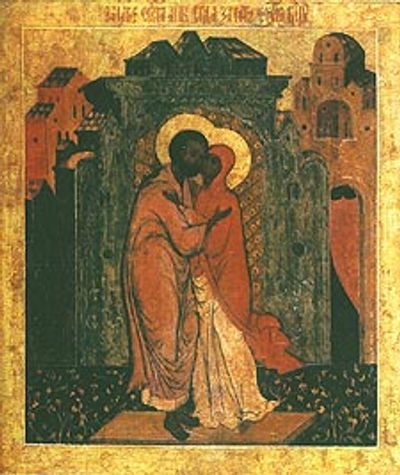
Maternity of the Holy Anna
Saint Anna, the mother of the Virgin Mary, was the youngest daughter of the priest Nathan from Bethlehem, descended from the tribe of Levi. She married Saint Joachim who was a native of Galilee.
For a long time Saint Anna was childless, but after twenty years, through the fervent prayer of both spouses, an angel of the Lord announced to them that they would be the parents of a daughter, Who would bring blessings to the whole human race.
Meatfare Saturday and Saturdays of the Great Fast

ALL SOULS SATURDAY
“The Holy Fathers were convinced that the commemoration of the departed by alms and sacrifices (Divine Liturgies) brings great comfort and benefit to them.”
The custom of offering prayers and sacrifices for the departed comes to us from the Old Testament. Holy Scripture praises the custom as holy and wholesome or pious, as is written in the II Book of Maccabees, ch. 12, v. 45: “lt is therefore, a holy and wholesome thought to pray for the dead that they may be loosed from sins.”
ln the Byzantine Rite, we commemorate the deceased every day at the Divine Liturgy immediately after the Consecration with the petition: “Remember, O Lord, all those who have departed in the hope of resurrection unto eternal life … N.N. … , and grant them rest where the light of Your face shines.” (Liturgy of St. John Chrysostom)
The Byzantine Church has, since the ninth century, established a special day of prayer for the departed popularly known as “Za dušna Subota” (Gr. Psycho-sabbaton; psyche-soul) which literally translated means Souls Saturday. Since the Synaxarion calls for the “universal commemoration” and prayer for “all the souls departed in the faith,” fittingly then, in English, we call these Saturdays – All Souls Saturdays.
ln the Byzantine Liturgical Year there are five All Souls Saturdays – namely, Meat Fare Saturday, the Second, Third and Fourth Saturdays of the Great Lent, and Pentecost Saturday. Meat-Fare Saturday as a special day of prayer for the deceased can be traced down to the sixth and seventh century, the time when the Typikon of St. Saba, known as the Jerusalem Typikon, had developed. On Meat-Fare Sunday we liturgically commemorate the Last Judgment (Mt. 25:31-46). Therefore, on the previous day, we, in our charity, intercede with the merciful Judge for the de ceased that they be placed at His right hand when He will come to judge the Living and the dead. During the ninth century, the Second, Third and Fourth Saturdays of Lent were also dedicated to the commemoration of the dead. On Pentecost Saturday we commemorate “all the departed souls since Adam” (cf. Pentecostarion).
Every year, just before Meat-Fare Saturday, the families give the lists of their departed loved ones (Hramoty) to the pastor with the request that they be mentioned at the services held for the deceased on the All Souls Saturday. Members of the family are encouraged to attend these services on the All Souls Saturdays for by their presence and by their personal prayers and receiving Holy Communion they strengthen the bond of love with their departed loved ones and indeed keep their memory everlasting!
PRAYER FOR THE DECEASED (Ascribed to St. John Chrysostom) O God of all spiritual and corporeal beings, You trampled death, broke the power of Satan and granted life to the whole world; now, O Lord, grant also rest to the soul of Your departed servant N. in a place of light, freshness, and peace, where there is no pain, sorrow, or mourning. As a gracious God and loving mankind, forgive him (her) every transgression committed by him (her) in word, deed, or thought, since there is no man alive who has not sinned. You alone are without sin and Your justice is everlasting justice, and Your word is always the truth. For You are the resurrection, the life and the rest of Your departed servant N., O Christ our God, and we render glory to You, together with Your Eternal Father, and Your most Holy, gracious, and life-giving Spirit, now and ever and forever. Amen.
Excerpt from Byzantine Leaflet Series No.6 With Ecclesiastical Approbation March, 1977 BYZANTINE SEMINARY PRESS Pittsburgh, Pa. 15214